



How to Buy Colombian Emeralds With Confidence
A fine Colombian emerald should not be chosen by carat weight alone. Its value lies in a rare combination of vivid natural color, pleasing transparency, an attractive cut, documented origin, and treatment that is appropriate for the stone. Knowing how to buy Colombian emeralds means learning to see those factors together, rather than allowing a single number or a dramatic photograph to decide the purchase.
For a collector, a milestone gift, or an heirloom ring, the right emerald has presence beyond its size. It will appear alive in changing light, hold its color without looking dark, and be represented with the level of documentation and craftsmanship its value deserves.
Start With Colombian Color
Colombia has produced many of the world's most celebrated emeralds, particularly from the historic regions of Muzo, Chivor, and Coscuez. Yet Colombian origin alone does not make an emerald exceptional. Color remains the first consideration.
The finest examples generally display a pure to slightly bluish green with strong saturation and a medium to medium-dark tone. The color should be rich enough to feel unmistakably emerald, while retaining sufficient brightness to be enjoyed from across a room. A stone that is too pale may lack distinction; one that is overly dark can appear inky or nearly black once set in jewelry.
View the emerald in more than one lighting environment. Daylight and soft indoor light reveal different aspects of color and transparency. Photographs are useful, but they can deepen saturation, conceal grayish undertones, or make a heavily included stone seem clearer than it is. A trusted jeweler should describe the color directly and show the actual gem whenever possible.
Judge Clarity With Emerald Standards, Not Diamond Standards
Emerald is a Type III gemstone, meaning inclusions are expected and commonly visible to the unaided eye. These internal features are often called jardin, the French word for garden. They can include fine fissures, mineral crystals, and feathery patterns created during the gem's formation.
The goal is not a flawless emerald. A natural Colombian emerald with no visible inclusions would be highly unusual and should be examined with particular care. Instead, look for a stone whose inclusions do not overpower its color, dull its transparency, or create an obvious durability concern.
Some inclusions are part of the stone's individuality. Others are more consequential. Surface-reaching fractures, large opaque areas beneath the table, and prominent cracks near the girdle can affect both beauty and long-term wear. This is where a careful in-person examination, preferably with magnification, matters. Ask whether any fracture reaches the surface and whether the setting protects vulnerable corners and edges.
Understand Treatment Before You Compare Prices
Most natural emeralds receive some clarity enhancement. This has been accepted within the gem trade for generations, especially when a colorless oil is used to reduce the visibility of surface-reaching fissures. The presence of treatment is not automatically a reason to decline a beautiful stone. The degree and nature of treatment are what matter.
A laboratory report may characterize enhancement as none, minor, moderate, or significant, depending on the laboratory's terminology. As a general rule, a fine emerald with no indications of clarity enhancement or only minor enhancement commands a greater premium than a visually similar stone with moderate or significant enhancement. This difference can be substantial, particularly in larger stones with strong color and documented Colombian origin.
Ask what material was used for enhancement. Traditional oil, often cedarwood oil, is generally regarded differently from resin or polymer filling. Resins can be more durable in some circumstances, but their use should be clearly disclosed because they may affect value and future care. No seller should describe an emerald simply as “natural” while leaving treatment unaddressed. Natural refers to the gemstone's formation, not necessarily to the absence of clarity enhancement.
Emeralds should not be exposed to ultrasonic cleaners, steam cleaning, or harsh chemicals. Warm water, a mild soap, and a soft brush are usually the prudent choice, followed by gentle drying. Proper care preserves both the stone and any enhancement present.
Why an Origin Report Matters
Colombian origin is a meaningful value factor when it is supported by a respected independent gem laboratory. Laboratories assess a gem's internal characteristics and compare them with known reference material to offer an expert opinion on geographic origin. It is an informed scientific conclusion, not a guarantee derived from a mine label.
For an emerald of notable quality or value, request a report that identifies the stone as natural beryl, states the observed clarity enhancement, and offers an origin opinion when determinable. GIA, American Gemological Laboratories, SSEF, and Gübelin are among the laboratories collectors may encounter. The report should correspond to the specific stone, including its weight and identifying details.
Not every emerald will receive an origin determination, and not every purchase requires one. A smaller emerald in a beautifully made ring may be purchased primarily for its design and color. However, when Colombian origin is part of the price justification, a credible origin report becomes especially important. The more exceptional the stone, the more important the documentation.
Look Beyond Carat Weight and Into the Cut
An emerald's face-up size can vary widely at the same carat weight. A shallow-cut stone may look larger but lose color and exhibit a window, a transparent area in the center that appears watery or see-through. An excessively deep stone can carry weight where it cannot be seen, making the gem look small for its stated carat weight.
The traditional emerald cut is popular for good reason. Its step facets can present color with calm, elegant depth while the clipped corners offer some protection. Oval, cushion, pear, and cabochon cuts can also be exceptional, provided the proportions suit the rough crystal and the finished gem shows even color across its face.
Examine the stone from a normal viewing distance, then more closely. Look for a balanced outline, well-defined facet junctions, and a lively return of light. A slight variation in color is not unusual in emerald, but a prominent window, dark dead area, or poorly centered cut should influence the price.
Evaluate the Entire Piece of Jewelry
When buying an emerald ring, pendant, or earrings, the setting is part of the investment in beauty and longevity. Emerald is not as hard or as forgiving as diamond. A protective design is particularly wise for a ring worn daily.
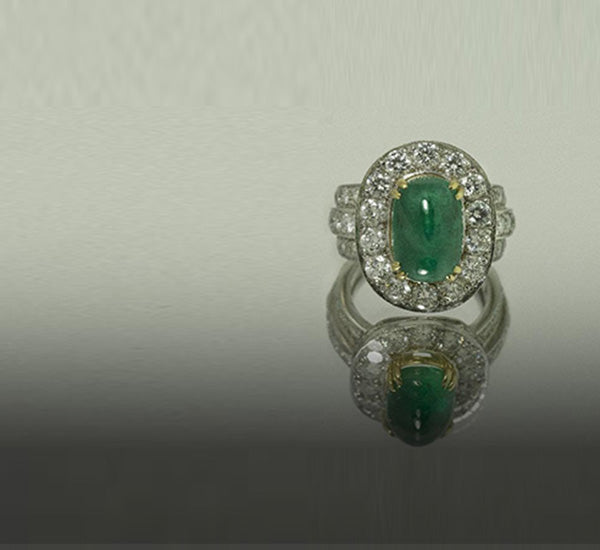
For rings, consider bezels, partial bezels, or thoughtfully placed prongs that guard the corners of an emerald cut. Prongs should be substantial enough to secure the stone without obscuring it. In a diamond-accented design, assess whether the diamonds complement the emerald rather than compete with it. Fine craftsmanship will show in clean metalwork, a secure mounting, balanced proportions, and a setting that allows light into the gem without leaving it exposed.
Metal color also changes the presentation. Yellow gold often intensifies an emerald's warmth and classic character. Platinum and white gold can create a cooler, more tailored contrast, especially when paired with diamonds. There is no universal best choice. The right setting depends on the emerald's undertone, the design period, and how the piece will be worn.
Ask for Specific Facts, Not General Assurances
A serious seller should be prepared to discuss the emerald plainly: its carat weight, measurements, origin report, clarity enhancement, cut, mounting metal, and any accompanying diamond quality. Request a copy of the laboratory report and confirm that the report number, weight, and stone description correspond to the jewelry being offered.
It is also reasonable to ask about condition, especially with estate jewelry. Has the emerald been repolished? Are there chips, abrasions, or evidence of previous repair? Is the setting secure? Vintage and antique jewels may show signs of age, but condition should be disclosed accurately and reflected in the price.
Price comparisons need context. Two Colombian emeralds of the same weight can differ dramatically in value because one has exceptional color, attractive transparency, minor oil, and a respected origin report while the other has darker color, significant filling, or no supporting documentation. A lower price may represent an opportunity, but it may also reflect compromises that are not apparent in a listing image.
Buy the Stone You Will Continue to Admire
The strongest purchase is usually not the largest emerald available within a budget. It is the stone whose color continues to hold your attention, whose treatment and origin are honestly represented, and whose setting suits a lifetime of wear. At Thayer Jewelers, that standard begins with selecting gems and estate pieces worthy of close examination, not simply impressive at first glance.
Take your time with a Colombian emerald. Let its color be the reason you pause, and let its documentation, condition, and craftsmanship give you every reason to keep it.